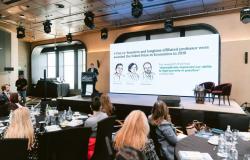


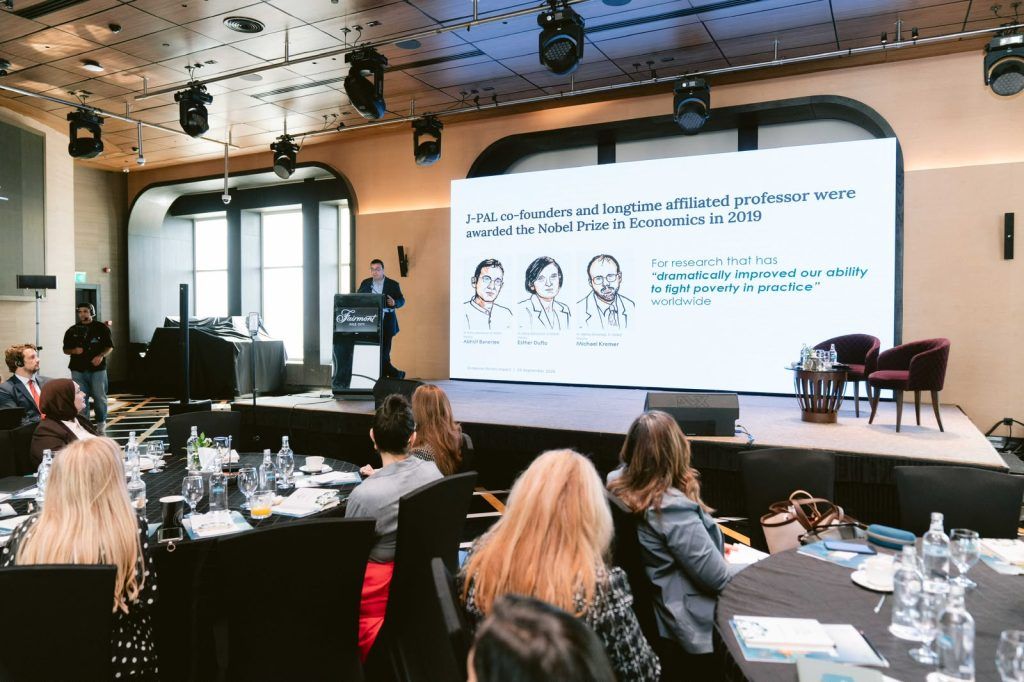
The Sawiris Foundation and the Abdul Latif Jameel Poverty Action Lab Middle East and North Africa (J-PAL MENA) at the American University in Cairo (AUC) brought together business, banking, development and research leaders to discuss how evidence and impact measurement can help direct social investments toward more effective and sustainable interventions.
The discussion took place during the “Evidence-Driven Impact” convening, which examined how research findings and results measurement can be incorporated into social investment decisions by companies, banks and donor organizations.
Participants emphasized the need to move beyond measuring programs solely by funding levels or the number of beneficiaries reached, focusing instead on the actual change achieved, its sustainability and the efficiency of resource use.
The Sawiris Foundation highlighted its Bab Amal Program as an example of an evidence-driven development model. The program combines economic and social support, livelihood development and intensive household follow-up, while using research and evaluation findings to continuously improve its approach.
To date, Bab Amal has reached approximately 14,000 families and contributed to a three- to fourfold increase in the value of household assets after 40 months, according to the Foundation.
The event also brought together representatives from Egypt’s Ministry of Social Solidarity, including Engy El Yamany, Executive Director of the Rural and Environmental Industries Support Fund (REIS), and Reem Abdel Latif, Monitoring and Evaluation Consultant for the Takaful and Karama Cash Transfer Program.
An open panel discussion featured Mariam Allam, Founder and Board Member of the Essam & May Allam Foundation for Sustainable Development; Shams Owais, Government Relations and Partnerships Director for North Africa, the Levant and Türkiye at Mars; Nahla Mokhtar Agour, Corporate Affairs, Engagement & Sustainability Director at L’Oréal Egypt; and Manal Hassan, Group Chief Sustainability Officer at Elsewedy Electric.
J-PAL MENA also presented research and evaluations across several development sectors, highlighting how scientific evidence can support institutional decision-making and help translate research findings into practical tools for program design and social investment.
Laila Hosny, Executive Director of the Sawiris Foundation, said that as development needs continue to grow while resources remain limited, directing funding toward effective interventions has become increasingly important.
She added that partnerships can bring together implementation experience, research, financing, technology and the capacity to scale, helping institutions make better decisions and develop more sustainable interventions.
Dr. Ahmed Elsayed, Executive Director of J-PAL MENA, emphasized the importance of using scientific evidence to determine whether social programs are actually making a difference. He noted that rigorous impact evaluations, including randomized controlled trials, can help determine whether programs work, why they work, for whom they work and at what cost.
The convening concluded with a discussion of practical steps for integrating evidence into decision-making, including defining the problem before selecting an intervention, reviewing existing research, establishing clear outcome indicators and using implementation lessons to improve future programs.
The “Evidence-Driven Impact” convening is part of the ongoing collaboration between the Sawiris Foundation and J-PAL MENA to strengthen the use of research and evaluation in development practice and support more effective and scalable social investments.
إخلاء مسؤولية إن موقع بالبلدي يعمل بطريقة آلية دون تدخل بشري،ولذلك فإن جميع المقالات والاخبار والتعليقات المنشوره في الموقع مسؤولية أصحابها وإداره الموقع لا تتحمل أي مسؤولية أدبية او قانونية عن محتوى الموقع.
"جميع الحقوق محفوظة لأصحابها"
المصدر :" سي نيوز "