

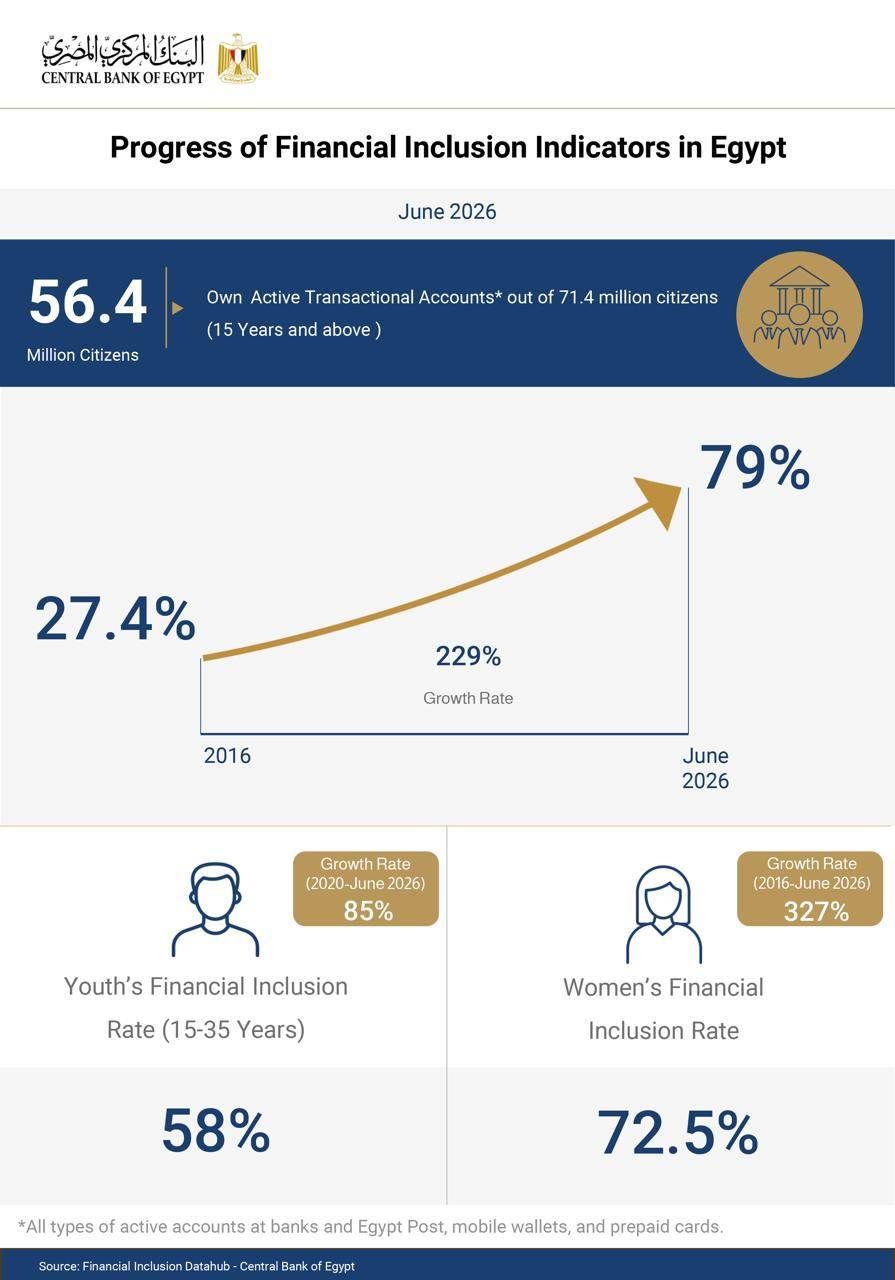
Financial inclusion rates in Egypt continued to increase, reaching 79% by the end of June 2026, to record 56.4 million citizens owning active accounts that enable them to perform financial transactions, out of total 71.4 million citizens (aged 15 years and above). This has been achieved as a result of the continued efforts of the Central Bank of Egypt (CBE) and the financial sector, to endorse financial inclusion and broaden access to financial services across all segments of society.
Active financial accounts encompass bank accounts, postal accounts, mobile wallets, and prepaid cards. In this regard, women’s financial inclusion rate rose substantially from 19.1% in 2016 to 72.5% by the end of June 2026, representing a growth rate of 327% over the aforementioned period. Similarly, the youth financial inclusion rate (aged 15 to 35 years) increased from 36.3% in 2020, to 58% in June 2026, marking a growth rate of 85% within the same period. These milestones were supported by tailored programs and initiatives aimed at enhancing the economic empowerment of women and youth, while integrating underserved segments into the formal financial system.
These accomplishments underscore the success of the Financial Inclusion Strategy (2022-2025) in achieving its objectives and promoting sustainable economic growth across all segments of society. The strategy was developed and implemented in consultation and coordination with relevant ministries and authorities. This progress is further reflected in the core set of indicators issued by the CBE’s Financial Inclusion Datahub, which showed a significant increase in both the ownership and usage of financial services, reflecting a growth rate of 229% over the period from 2016 to June 2026.
These results come as part of the ongoing cooperation and coordination with relevant ministries and authorities to implement several projects and initiatives. Leading these efforts are the presidential initiative "Decent Life" (Haya Karima) and the “Transforming the Livelihoods of Smallholder Farmers” project, as well as initiatives targeting women and youth, implemented in cooperation with the Ministry of Youth and Sports and the National Council for Women.
In alignment with the evidence-based approach adopted by the CBE to achieve its vision and objectives, the Second National Financial Inclusion Strategy (2026–2030) is currently under development, in collaboration with relevant ministries and authorities. The Strategy adopts a comprehensive approach that extends beyond providing access to financial services to promoting their effective, secure, and sustainable use, thereby supporting businesses and entrepreneurs, while integrating the informal economy into the formal one.
The new Strategy is being developed based on a comprehensive methodology for measuring financial inclusion from the supply and demand sides, thereby strengthening its core dimensions: access, usage, and quality of financial services. It also relies on the findings of the financial services demand side survey, conducted with technical assistance from the World Bank (WB) and the International Finance Corporation (IFC), and implemented in cooperation with the Central Agency for Public Mobilization and Statistics (CAPMAS) during the first quarter of 2026. The survey aims at identifying existing gaps and barriers to the effective use of financial services, as well as drafting and formulating evidence-based policies.
The Strategy seeks to expand the use of financial services and products by advancing digital solutions and innovation, supporting the transition to a green economy through sustainable finance instruments, and raising financial awareness among citizens through financial education and literacy programs. It also aims to strengthen trust in the financial sector by reinforcing consumer protection, supporting the growth and sustainability of Small and Medium-sized Enterprises (SMEs) and entrepreneurs, fostering public-private partnerships, and advancing financial and technological infrastructure.
إخلاء مسؤولية إن موقع بالبلدي يعمل بطريقة آلية دون تدخل بشري،ولذلك فإن جميع المقالات والاخبار والتعليقات المنشوره في الموقع مسؤولية أصحابها وإداره الموقع لا تتحمل أي مسؤولية أدبية او قانونية عن محتوى الموقع.
"جميع الحقوق محفوظة لأصحابها"
المصدر :" بنكي "